Table of Contents
- Introduction to Levels of Measurement
- Nominal Level of Measurement
- Ordinal Level of Measurement
- Interval Level of Measurement
- Ratio Level of Measurement
- Case Study: Applying Levels of Measurement in Clinical Practice
- Importance of Understanding Levels of Measurement in Mental Health
- Conclusion
- References
As mental health professionals, we rely on various assessment tools and research methods to understand our clients and improve our practice. At the heart of these tools lies a fundamental concept: levels of measurement. Mastering the four levels of measurement - nominal, ordinal, interval, and ratio - is crucial for accurate data interpretation and informed clinical decision-making. In this comprehensive guide, we'll explore each level in depth, providing relevant examples for mental health professionals and discussing their implications for research and assessment.
Introduction to Levels of Measurement
In the field of psychology and mental health, accurate measurement is essential for effective diagnosis, treatment planning, and research. The concept of levels of measurement, introduced by psychologist Stanley Smith Stevens in 1946, provides a framework for understanding the nature of data and how it can be analyzed and interpreted.
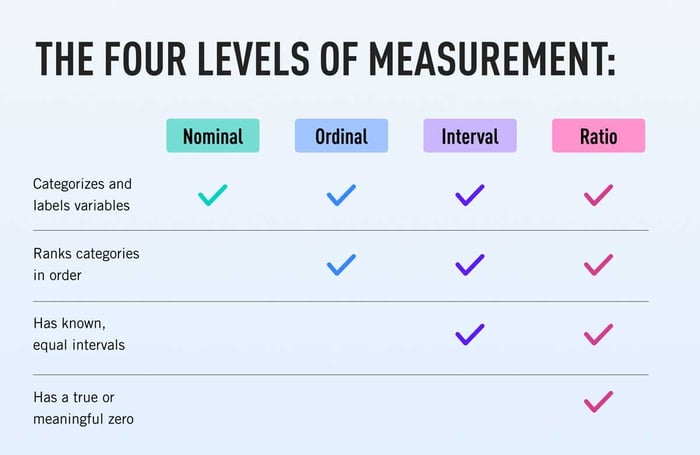
The four levels of measurement are:
- Nominal
- Ordinal
- Interval
- Ratio
Each level builds upon the previous one, offering increasing precision and mathematical possibilities. Understanding these levels is crucial for selecting appropriate statistical analyses and drawing valid conclusions from data.
Nominal Level of Measurement
The nominal level is the most basic level of measurement. It involves categorizing data into mutually exclusive groups without any inherent order or numerical value.
Key characteristics:
- Categories are mutually exclusive
- No inherent order or ranking
- Cannot perform mathematical operations
Examples in mental health:
- Diagnostic categories (e.g., depression, anxiety, bipolar disorder)
- Gender identity
- Marital status
- Treatment modalities (e.g., CBT, psychodynamic therapy, EMDR)
Statistical analyses:
- Mode
- Frequency distribution
- Chi-square test
Application in practice:
When using nominal data, mental health professionals can categorize clients or responses without implying any hierarchy. For instance, recording a client's preferred therapeutic approach (e.g., CBT, psychodynamic, or humanistic) helps in treatment planning without suggesting that one approach is inherently better than another.
Ordinal Level of Measurement
The ordinal level of measurement involves categories that have a meaningful order or ranking, but the intervals between categories are not necessarily equal or known.
Key characteristics:
- Categories have a defined order
- Differences between categories are not quantifiable
- Can use greater than or less than comparisons
Examples in mental health:
- Likert scales (e.g., strongly disagree to strongly agree)
- Severity ratings (e.g., mild, moderate, severe)
- Educational levels
- Stages of change in addiction treatment
Statistical analyses:
- Median
- Percentiles
- Spearman's rank correlation
- Mann-Whitney U test
Application in practice:
Ordinal data is commonly used in mental health assessments. For example, the PHQ-9 depression screening tool uses ordinal categories to measure the frequency of depressive symptoms. While we know that "nearly every day" indicates more frequent symptoms than "several days," we can't assume that the difference between these categories is mathematically equal.
Interval Level of Measurement
The interval level of measurement involves numerical scales where the intervals between values are equal, but there is no true zero point.
Key characteristics:
- Equal intervals between values
- No true zero point
- Can perform addition and subtraction
Examples in mental health:
- IQ scores
- Standardized test scores (e.g., MMPI-2)
- Temperature scales (e.g., Celsius, used in biofeedback)
Statistical analyses:
- Mean
- Standard deviation
- Pearson's correlation
- t-tests
- ANOVA
Application in practice:
Interval data allows for more sophisticated statistical analyses. For instance, when comparing IQ scores, we can say that the difference between scores of 100 and 110 is the same as the difference between 110 and 120. This enables more precise comparisons and analyses in research and assessment.
Ratio Level of Measurement
The ratio level is the highest level of measurement, featuring all the characteristics of interval data plus a true zero point.
Key characteristics:
- Equal intervals between values
- True zero point
- Can perform all mathematical operations (addition, subtraction, multiplication, division)
Examples in mental health:
- Age
- Response time in cognitive tests
- Number of therapy sessions attended
- Physiological measurements (e.g., heart rate, cortisol levels)
Statistical analyses:
- All statistical tests applicable to interval data
- Geometric mean
- Coefficient of variation
Application in practice:
Ratio data provides the most flexibility in statistical analysis. For example, when measuring the duration of depressive episodes, we can say that a 6-month episode is twice as long as a 3-month episode. This level of precision allows for more nuanced analysis and interpretation of data in research and clinical practice.
Case Study: Applying Levels of Measurement in Clinical Practice
Dr. Sarah Thompson, a clinical psychologist, is conducting a comprehensive assessment of a new client, Mark, who is seeking help for anxiety and depression. Let's examine how she applies different levels of measurement throughout her assessment process.
Nominal Level:
Dr. Thompson begins by recording demographic information:
- Gender: Male
- Marital Status: Single
- Employment Status: Employed
She also notes Mark's preliminary diagnosis:
- Primary Diagnosis: Generalized Anxiety Disorder (GAD)
- Secondary Diagnosis: Major Depressive Disorder (MDD)
Ordinal Level:
Dr. Thompson administers the GAD-7 and PHQ-9 screening tools, which use Likert scales:
- GAD-7 Score: 15 (Severe anxiety)
- PHQ-9 Score: 18 (Moderately severe depression)
She also assesses Mark's stage of change regarding his anxiety management:
- Stage of Change: Contemplation
Interval Level:
As part of a comprehensive evaluation, Dr. Thompson administers an IQ test:
- Full-Scale IQ Score: 112
Ratio Level:
Dr. Thompson collects the following data:
- Age: 32 years
- Duration of current depressive episode: 8 months
- Number of panic attacks in the past month: 6
- Average hours of sleep per night: 5.5
By understanding and appropriately applying these levels of measurement, Dr. Thompson can:
- Accurately categorize Mark's symptoms and diagnoses
- Compare the severity of his anxiety and depression to standardized norms
- Analyze the relationship between his cognitive abilities and symptom presentation
- Precisely quantify aspects of his experience, such as sleep patterns and panic attack frequency
This comprehensive approach, grounded in a solid understanding of measurement levels, allows Dr. Thompson to develop a more nuanced and effective treatment plan for Mark.
Importance of Understanding Levels of Measurement in Mental Health
Mastering the four levels of measurement - nominal, ordinal, interval, and ratio - is crucial for mental health professionals for several reasons:
- Accurate Data Interpretation: Understanding levels of measurement helps professionals interpret assessment results correctly, avoiding errors in diagnosis and treatment planning.
- Appropriate Statistical Analysis: Knowing the level of measurement guides the selection of appropriate statistical tests, ensuring valid research conclusions and evidence-based practice.
- Effective Communication: It enables clear communication of research findings and clinical observations among professionals and in academic publications.
- Improved Assessment Design: Understanding measurement levels aids in developing more precise and valid assessment tools for mental health conditions.
- Enhanced Clinical Decision-Making: A solid grasp of measurement levels allows for more nuanced interpretation of client data, leading to better-informed treatment decisions.
- Research Validity: In conducting or consuming research, knowledge of measurement levels helps in critically evaluating study designs and results.
- Ethical Practice: Proper understanding and application of measurement levels contribute to ethical practice by ensuring accurate representation and interpretation of client data.
For mental health professionals seeking to enhance their skills in this area, continuing education is essential. Therapy Trainings™ offers a range of CE courses approved by boards across the nation, including specialized training in research methods and assessment techniques.
Conclusion
Understanding the four levels of measurement - nominal, ordinal, interval, and ratio - is fundamental to effective practice in mental health. From accurately categorizing diagnoses to precisely measuring symptom severity and treatment outcomes, these concepts underpin much of our work as mental health professionals.
As the field of mental health continues to evolve, staying current with best practices in measurement and assessment is crucial. Therapy Trainings™ is committed to supporting your professional development in this area. We offer a wide range of continuing education courses designed to enhance your skills in research methods, assessment, and data interpretation.
Grasping the levels of measurement—nominal, ordinal, interval, and ratio—is essential for therapists to effectively analyze and apply research data, and to complement this knowledge, exploring Maslow's Hierarchy of Needs can provide a deeper understanding of how to prioritize and address clients' core motivational needs within therapeutic practice. Or, you might want to explore the Educational Therapy Toolkit which can provide practical tools to enhance educational strategies and interventions within therapy sessions.
Take the next step in your professional development:
- Explore our comprehensive CE course catalog to find courses that match your interests and professional needs.
- Enroll in our specialized course on "Advanced Measurement and Assessment in Mental Health Practice" to deepen your understanding of these crucial concepts.
- Join our community of mental health professionals dedicated to evidence-based practice and continuous learning.
By investing in your knowledge of measurement levels and assessment techniques, you're not just fulfilling CE requirements - you're enhancing your ability to provide the best possible care for your clients.
Visit therapytrainings.com today to start your journey towards mastering the levels of measurement and elevating your clinical practice.
References
- Stevens, S. S. (1946). On the Theory of Scales of Measurement. Science, 103(2684), 677-680. https://doi.org/10.1126/science.103.2684.677
- American Psychological Association. (2020). Publication manual of the American Psychological Association (7th ed.). https://doi.org/10.1037/0000165-000
- Coolican, H. (2018). Research Methods and Statistics in Psychology (7th ed.). Routledge.
- Kazdin, A. E. (2021). Research Design in Clinical Psychology (5th ed.). Cambridge University Press.
- National Institute of Mental Health. (2023). Mental Health Information. https://www.nimh.nih.gov/health