Table of Contents
As a mental health professional, you have probably encountered clients who ask for practical ways to manage stress, anxiety, or low mood between sessions. While therapy provides an important space for reflection and growth, clients often benefit from having simple, accessible activities they can turn to in their everyday lives.
Structured creative activities have received increasing attention within mental health research. Unlike open-ended artistic expression, which can sometimes feel intimidating or overwhelming, structured formats provide clear expectations and a manageable starting point. Activities such as coloring, guided drawing, and other step-by-step creative exercises offer a balance between engagement and predictability that many adults find calming.
Recent research suggests these activities may contribute to improved emotional well-being, reduced stress, and greater psychological flexibility. Understanding why they work and how they differ from formal art therapy can help clinicians make informed recommendations for appropriate clients.
What the Research Says About Structured Art Activities
A growing body of evidence supports the value of creative engagement for mental health. Recent meta-analytic research suggests that art-based interventions can produce meaningful improvements in emotional well-being across a range of populations.
A 2026 meta-analysis by Qiao et al., published in the Journal of Psychiatric and Mental Health Nursing, examined 14 studies involving 861 participants and found that art therapy for adult depression produced moderate-to-large positive effects. Benefits were particularly pronounced among older adults, individuals participating in longer interventions, and those receiving individual rather than group-based support.
Research on anxiety has produced similar findings. Mizera and Krysta (2025) conducted a systematic review in Psychiatria Danubina that included 14 randomized controlled trials with approximately 1,686 participants. Across all studies, visual art interventions were associated with significant reductions in anxiety symptoms, regardless of whether the intervention lasted for a single session or several weeks.
Perhaps one of the most interesting findings for clinicians comes from a 2025 meta-analysis published in Nature Mental Health. Researchers found that the specific artistic medium did not significantly influence outcomes. Visual art, music, dance, and other creative activities all demonstrated comparable benefits for depression and anxiety. This suggests that the therapeutic mechanisms involved may be more important than the particular form of creative expression.
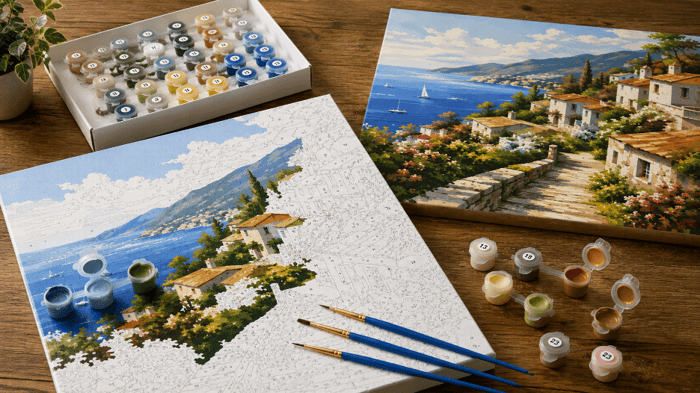
For some individuals, a paint by number for adults activity can provide an approachable way to engage with creativity without the uncertainty of starting from a blank page. The structured nature of the task may make participation easier for people who feel intimidated by traditional artistic activities.
Moezzi et al. (2026), writing in Frontiers in Human Neuroscience, explored some of the physiological processes involved in art-based interventions. Their review found evidence that creative activities may reduce cortisol levels, lower heart rate, and increase activation in brain regions associated with attention regulation and emotional control.
The Difference Between Art Therapy and Therapeutic Art-Making
It is important to distinguish between clinical art therapy and therapeutic art-making.
Art therapy is a specialized mental health profession that requires advanced training, supervision, and credentialing. Art therapists use creative processes as part of a structured therapeutic relationship to assess, treat, and support clients with a wide range of psychological concerns.
Therapeutic art-making, on the other hand, refers to creative activities that may support well-being but are not conducted as formal therapy. These activities can still offer meaningful psychological benefits, but they do not replace clinical treatment.
Lawrence C. Rubin, PhD, discussed this distinction in a foundational article published in The Arts in Psychotherapy. His work described several ways structured art activities can be incorporated into therapeutic settings, including supporting relaxation, encouraging self-expression, and facilitating discussion around personal experiences.
At the same time, Rubin noted that structured creative tasks are not universally beneficial. Individuals with significant perfectionistic tendencies or obsessive patterns may become overly focused on completion, accuracy, or performance. In such cases, clinicians should carefully consider whether a structured activity supports or reinforces existing difficulties.
The Government of Western Australia's Department of Health similarly emphasizes that therapeutic value comes from the process of creative engagement rather than the quality of the final product. This process-oriented perspective aligns with broader recovery-focused approaches in mental health care.
Why Structure Can Be Helpful
One reason structured creative activities appear effective is their ability to support focused attention.
Psychologist Mihaly Csikszentmihalyi described the concept of flow as a state of deep engagement in which individuals become fully absorbed in an activity. Flow is often associated with reduced self-consciousness, improved concentration, and a temporary reduction in awareness of external stressors.
Structured creative tasks naturally support many of the conditions associated with flow. Goals are clear, feedback is immediate, and expectations are defined. Participants know what to do next without needing to constantly make decisions about the process.
This may be particularly relevant for clients experiencing decision fatigue. Individuals dealing with anxiety, ADHD, burnout, or chronic stress often report feeling mentally exhausted by everyday choices. Open-ended creative activities can unintentionally add to this burden by requiring decisions about materials, colors, composition, and technique.
Structured activities reduce that cognitive load. By limiting the number of choices required, they allow attention to shift toward the experience itself rather than the process of planning or evaluating performance.
Many mindfulness-based art practices operate through similar mechanisms. Activities such as mandala coloring, mindful doodling, and guided drawing encourage sustained attention while providing enough structure to prevent overwhelm. These approaches help anchor individuals in the present moment without demanding intensive cognitive effort.
Clinical Applications for Mental Health Professionals
Structured creative activities may be useful for a variety of client populations when appropriately framed.
Clients experiencing anxiety often benefit from predictable, repetitive activities that encourage focused attention and reduce physiological arousal. The repetitive nature of many structured art tasks may support relaxation while providing a healthy outlet for nervous energy.
Individuals living with depression may find structured activities easier to initiate than more open-ended hobbies. When motivation is low, having a clearly defined task can reduce the psychological barriers associated with getting started. Small moments of progress may also help reinforce a sense of accomplishment and agency.
Clients with ADHD may appreciate the combination of sensory engagement and external structure. Clearly defined steps can reduce executive functioning demands while maintaining interest and focus.
Older adults represent another population that may benefit from creative engagement. Research consistently demonstrates positive effects of art-based activities on mood, cognitive stimulation, and overall well-being within this group.
When discussing these activities with clients, framing matters. The goal is not to create something impressive or beautiful. Instead, the focus should remain on engagement, curiosity, and the experience itself. Encouraging clients to observe their thoughts, emotions, and physical sensations before, during, and after the activity can help strengthen self-awareness and mindfulness skills.
Clinicians should also recognize when a referral to a credentialed art therapist may be more appropriate. Individuals with significant trauma histories, severe emotional dysregulation, dissociation, or complex therapeutic needs may benefit from specialized support rather than independent creative activities.
Conclusion
Structured creative activities occupy a useful space within the broader mental health landscape. Research from recent years suggests they can support emotional regulation, reduce stress, encourage focused attention, and contribute to overall psychological well-being.
Although these activities should not be confused with formal art therapy, they may serve as valuable complementary practices for many clients. Their accessibility, predictability, and low barrier to entry make them particularly appealing for individuals who feel overwhelmed by more open-ended forms of creative expression.
For clinicians, understanding the potential benefits and limitations of structured art activities can expand the range of practical tools available to support clients between sessions. In the right context, even a simple creative practice can become a meaningful part of a person's mental health routine.