As mental health professionals, understanding the intricacies of human psychological development is crucial for providing effective therapy. One significant area of study that has profound implications for therapeutic practice is Lawrence Kohlberg's theory of moral development. This comprehensive guide will explore Kohlberg's stages of moral development and their practical applications in therapy, particularly in adolescent and adult counseling.
What is Kohlberg's Theory of Moral Development?
Lawrence Kohlberg, an American psychologist, expanded on Jean Piaget's work to propose a theory of moral development that extends from childhood through adulthood. His theory suggests that moral reasoning, the basis for ethical behavior, has six identifiable developmental stages.
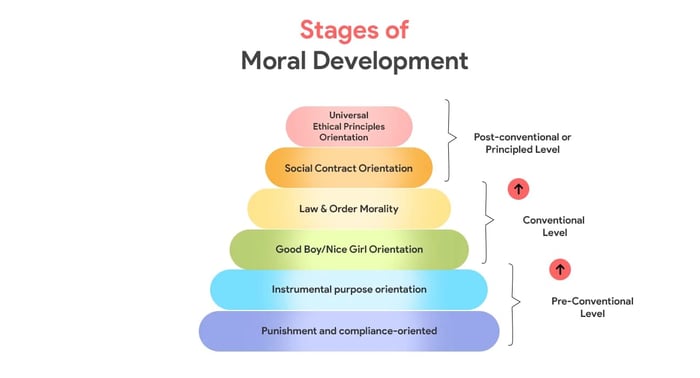
The Six Stages of Moral Development
Kohlberg's theory is divided into three levels, each containing two stages:
- Pre-conventional Level
- Stage 1: Obedience and Punishment Orientation
- Stage 2: Self-Interest Orientation
- Conventional Level
- Stage 3: Interpersonal Accord and Conformity
- Stage 4: Authority and Social-Order Maintaining Orientation
- Post-conventional Level
- Stage 5: Social Contract Orientation
- Stage 6: Universal Ethical Principles
Let's explore each stage in detail and discuss its relevance to therapeutic practice.
Pre-conventional Level
Stage 1: Obedience and Punishment Orientation
At this stage, individuals focus on the direct consequences of their actions on themselves. Their moral decisions are shaped by obedience to authority and avoiding punishment.
Therapeutic Implications: When working with clients at this stage, therapists may need to focus on helping them understand the broader implications of their actions beyond immediate consequences.
Stage 2: Self-Interest Orientation
Here, individuals recognize that there is not just one right view that is handed down by authority. They pursue their own interests but also recognize that others have interests too.
Therapeutic Implications: Therapists can work on developing empathy and perspective-taking skills in clients at this stage.
Conventional Level
Stage 3: Interpersonal Accord and Conformity
At this stage, individuals are concerned about social relationships and the expectations of others. They try to be a "good person" to live up to these expectations.
Therapeutic Implications: Therapists can help clients at this stage to develop a stronger sense of self and to balance their own needs with social expectations.
Stage 4: Authority and Social-Order Maintaining Orientation
Individuals at this stage consider society as a whole when making moral judgments. They emphasize following societal rules and fulfilling duties to maintain social order.
Therapeutic Implications: Therapists can encourage critical thinking about societal norms and help clients develop a more nuanced understanding of morality.
Post-conventional Level
Stage 5: Social Contract Orientation
At this stage, individuals become aware that while rules and laws are important for maintaining a society, they can be changed if they no longer serve their purpose.
Therapeutic Implications: Therapists can engage clients in discussions about complex ethical dilemmas and encourage them to consider multiple perspectives.
Stage 6: Universal Ethical Principles
This is the highest stage of moral reasoning, where individuals follow internalized principles of justice, even if they conflict with laws and rules.
Therapeutic Implications: Therapists can help clients at this stage to align their actions with their deeply held principles and to navigate conflicts between personal ethics and societal norms.
Practical Applications in Therapy
Understanding Kohlberg's stages of moral development can significantly enhance therapeutic interventions. Here are some practical ways to apply this knowledge:
- Assessment: Use Kohlberg's theory to assess a client's current stage of moral reasoning. This can provide valuable insights into their decision-making processes and potential areas for growth.
- Tailored Interventions: Design interventions that are appropriate for the client's current stage of moral development. For example, a client at Stage 3 might benefit from exercises that encourage them to consider the broader societal implications of their actions.
- Ethical Dilemma Discussions: Present hypothetical ethical dilemmas to clients and discuss their reasoning. This can help clients develop more sophisticated moral reasoning skills.
- Values Clarification: Help clients identify and articulate their personal values, which can be particularly useful for those transitioning between stages.
- Cognitive Restructuring: Challenge and reframe moral beliefs that may be limiting the client's growth or causing distress.
- Role-Playing: Use role-playing exercises to help clients practice applying higher-level moral reasoning in real-life scenarios.
Case Study: Applying Kohlberg's Theory in Adolescent Therapy
Let's consider the case of Alex, a 16-year-old who was referred to therapy due to behavioral issues at school. Through initial assessment, the therapist determined that Alex was primarily operating at Stage 2 of Kohlberg's model, making decisions based on self-interest with little consideration for others.
Intervention: The therapist designed a series of sessions focused on developing empathy and perspective-taking skills. This included:
- Discussing scenarios from different viewpoints
- Engaging in role-playing exercises
- Volunteering at a local community center
Outcome: Over six months, Alex showed significant progress. He began to consider the feelings of others in his decision-making process, indicating a move towards Stage 3. His behavior at school improved, and he reported better relationships with peers and family members.
This case illustrates how understanding and applying Kohlberg's theory can inform effective therapeutic interventions and lead to meaningful client growth.
Enhancing Your Therapeutic Skills
As a mental health professional, deepening your understanding of moral development theories like Kohlberg's can significantly enhance your ability to address ethical dilemmas with clients and provide more effective interventions.
Kohlberg's Theory of Moral Development provides valuable insights for therapists in understanding the stages of moral reasoning in clients, while Maslow's Hierarchy of Needs complements this by offering a framework for addressing fundamental psychological and emotional needs and exploring both approaches that can enhance therapeutic strategies by integrating moral and developmental perspectives with a focus on human motivation and well-being. You might also want to explore teleology in therapy, which adds a complementary layer by focusing on the purpose and goals behind a client's behaviors and decisions, and integrating these perspectives can deepen a therapist's ability to guide clients toward ethical growth and purposeful living.
Moreover, to further develop your skills in this area, consider exploring the continuing education courses offered by Therapy Trainings™. Our comprehensive range of courses covers various aspects of psychological development and therapeutic techniques, including in-depth explorations of moral development theories and their applications in clinical practice.
At Therapy Trainings™, we pride ourselves on offering CE courses approved by boards across the nation, ensuring that you can meet your continuing education requirements while gaining valuable, practical knowledge to enhance your therapeutic practice.
Conclusion
Kohlberg's stages of moral development provide a valuable framework for understanding how individuals reason about ethical issues. By incorporating this knowledge into your therapeutic approach, you can better assess clients' moral reasoning, tailor interventions to their developmental stage, and guide them towards more sophisticated ethical thinking.
Remember, as mental health professionals, our own continuing education is crucial for providing the best possible care to our clients. Explore the courses available at therapytrainings.com to stay at the forefront of therapeutic practices and theories.
References
- Kohlberg, L. (1981). Essays on Moral Development, Vol. I: The Philosophy of Moral Development. Harper & Row.
- Rest, J., Narvaez, D., Bebeau, M. J., & Thoma, S. J. (1999). Postconventional moral thinking: A Neo-Kohlbergian approach. Psychology Press.
- Gibbs, J. C. (2013). Moral development and reality: Beyond the theories of Kohlberg, Hoffman, and Haidt. Oxford University Press.
- American Psychological Association. (2017). Ethical principles of psychologists and code of conduct. https://www.apa.org/ethics/code
- Stanford Encyclopedia of Philosophy. (2018). Moral Development. https://plato.stanford.edu/entries/moral-development/