
Table of Contents
Why Academic Self-Discovery Matters
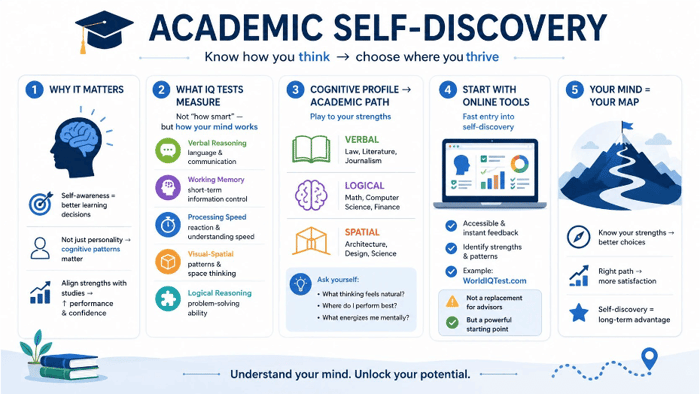
In the journey through higher education, one of the most powerful assets a student can have is self-awareness. Knowing how you think - your cognitive tendencies, your problem-solving style, your mental strengths - can shape how you approach learning, decision-making, and your future career. Self-discovery isn't just about personality; it’s about understanding your brain’s unique architecture.
Some students excel in logical reasoning, while others are stronger in abstract or verbal thinking. Without clarity on these differences, a student may find themselves in the wrong academic path, simply because it doesn’t align with how they naturally process information. For instance, someone with strong spatial and visual reasoning may feel frustrated in a text-heavy discipline, not realizing they could thrive in fields like engineering, architecture, or data visualization.
Academic self-discovery helps close this gap. By aligning one’s natural cognitive preferences with the right learning environment, students can boost performance, confidence, and long-term satisfaction.
What an IQ Test Really Measures
While most people are familiar with the term “IQ test,” fewer understand what it actually measures. IQ (Intelligence Quotient) testing doesn’t provide a single magical number that defines your intellect - it measures a range of cognitive abilities, which can offer valuable insights into how your brain works.
Key components of a typical IQ or cognitive test include:
Verbal reasoning - understanding and using language effectively
Working memory - holding and manipulating information short-term
Processing speed - how quickly you can understand and respond to information
Visual-spatial reasoning - understanding spatial relationships and patterns
Logical reasoning - solving structured problems and puzzles
These areas reveal distinct aspects of intelligence. Understanding which areas you score higher in can help you grasp not just how smart you are, but how your intelligence works—and that’s where the journey of academic self-discovery begins.
How Cognitive Profiling Supports Academic Direction
Once students understand their cognitive strengths and weaknesses, they’re better equipped to make informed choices—especially when it comes to selecting majors, careers, or study strategies.
For example:
A student with high verbal reasoning may gravitate toward law, literature, or journalism.
Someone strong in logical or analytical thinking may excel in mathematics, computer science, or finance.
A person with high spatial reasoning might be better suited to architecture, design, or the natural sciences.
This kind of profiling doesn’t box students into one path—it opens doors by helping them ask the right questions: What kind of thinking energizes me? What fields reward my way of solving problems? Where am I most likely to feel intellectually at home?
That insight is incredibly powerful in a university environment where exploration and specialization go hand in hand.
Identifying Your Strengths with Online IQ Tools
Many students assume they need a formal psychologist or expensive testing to get this kind of information. Fortunately, that's no longer the case. Today’s online IQ testing platforms offer fast, accessible tools to begin your self-discovery journey. For example WorldIQTest.com - platform that provides a free online IQ test that gives immediate feedback across various cognitive areas. While the free version offers basic results, it’s a useful snapshot of your cognitive profile—enough to start noticing patterns and areas where you shine. For those seeking deeper insight, extended analytics and certificates are also available.
This kind of tool isn’t meant to replace deep academic advising—but it can give you a valuable starting point for personal reflection, goal setting, and academic planning.
Your Mind, Your Map
Understanding your cognitive profile is more than just curiosity—it’s a powerful tool for academic and personal growth. IQ testing, when used thoughtfully, can guide students toward subjects, careers, and challenges that match their strengths. In a world of endless academic options, knowing yourself might just be your greatest advantage.
Whether you're choosing a major or rethinking your study approach, taking time for academic self-discovery through cognitive testing can be the key to unlocking your full potential.