
Table of Contents
The right voice is an excellent instrument that has the power to transform the way information is received and processed, especially in sensitive areas like mental health and mentoring. It is not merely a soothing tone; it is a help towards building trust, empathy, and a safe, interactive learning environment. A poorly selected voice can be distracting, disengaging, or even jarring, while the exact right voice has the ability to have a profound effect and leave the listener heard, understood, and led along the way.
For course creators, choosing the perfect voice is an important decision with a direct effect on the effectiveness and emotional impact of their content.
Here's a guide to help you choose the right voice for your mental health or coaching course.
What are the Psychological Effects of Vocal Traits?
The human voice is a multicomponent instrument with different features that influence the subconscious mind of the listener. Familiarity with these psychological principles is paramount to making an educated decision for your classes. The traits of a voice, including pitch, pace, and tone, can greatly impact how a message is understood and remembered.
Here’s how:
Tone and Emotional Connection
Tone expresses the attitude and emotion of the speaker. In coaching and mental health, a calm, warm, and empathetic voice is essential. It is able to relax a listener and make them comfortable enough to open up about sensitive subjects. In contrast, an angry, monotonous, or excessively peppy voice is likely to sound alienating or insincere. Too rapid a voice may sound urgent or nervous, and too slow a voice may sound condescending or boring. The aim is to achieve a tone that is professional and friendly at the same time, creating a rapport and sense of trust.
Pitch and Authority
Pitch, or the highness or lowness of voice, is also important. According to research, although higher pitches tend to be seen as more energetic or friendly, a relatively low pitch is linked with calmness, authority, and credibility. Nonetheless, this is not a hard-and-fast rule; an unnaturally high or low voice can be distracting. The trick is to establish a pitch that feels natural and comfortable, asserting the speaker's authority without being overwhelming.
Pace and Comprehension
The pace, or the rate of speech, is also an important component. Typically, in psychological well-being and coaching, a moderate and consistent pace is suggested. Talking too fast can overload the listener and hinder the ability to take incomplex or emotional information. Deliberate pauses can be extremely powerful, with the listener provided time to integrate information and reflect. This produces a more reflective and present learning experience, which is perfect for personal growth subjects.
Finding Your Authentic Voice: Building Connection and Trust
Apart from the technical vocal attributes, authenticity is even more crucial in deciding on a voice for your courses. Listeners, particularly in online learning, are extremely sensitive to whether a voice comes across as authentic. A voice that sounds as though the speaker believes in the information they're presenting will gain credibility and trust sooner.
Fortunately, AI voices have made significant strides, and some advanced video dubbing tools like Murf.ai offer a selection of AI voices that capture the nuances and emotional complexity of a human voice. So, compare the different tools, take your time to listen to each of the different AI voices, and then make your decision. Such tools are giving tough competition to voice actors and revolutionizing the dubbing industry.
Another important aspect to remember when looking for the right voice for your course is your target audience. Who is your audience? Are they young adults struggling with anxiety, experienced professionals seeking leadership coaching, or new parents working through emotional issues? The perfect voice needs to have an appeal to your target audience. For a teen-oriented course, a youthful and friendly-voiced voice may prove to be the most suitable. For corporate coaching, a mature, authoritative tone would be better suited. Observe what your target audience likes and try out various voices to determine which one makes the greatest impact.
A voice that brings forth a feeling of safety and non-judgment is most important, as listeners might be in an emotionally vulnerable position.
Practical Steps to Selecting the Perfect Voice
Choosing the right voice is a strategic process. The following are some practical steps to help you:
Step 1: Determine Your Course's Persona
Even prior to listening to voice samples, define the persona of your course. What is its emotional tone and fundamental message? Is it a meditation, soothing course in mindfulness, or an inspirational, energized program in career development? The voice has to be an expression of this persona.
Step 2: Consider Technical Quality
The best voice in the world won't do if the quality of the sound is terrible. Ensure that the voice actor or narrator employs professional-quality equipment and a noise-free setting for the recording. Background noise, static, or distortion has no place. The audio has to be clear, clean, and even in every module.
If you do not have the budget for a voice actor but don't want to compromise quality, compare the different AI voice tools.You can use these tools to finish dubbing for your course videos in less time than it would take a voice actor.
Step 3: Audition Multiple Voices
Don't accept the first voice you get. Ask a few voice actors for auditions. Provide them with a brief script from your class, ideally one that has various emotions or various kinds of information (e.g., a technical overview followed by an inspirational statement). This will allow you to witness how they interpret various portions of the content. Listen carefully to their vocal texture, clarity, and articulation.
Again, if voice actors do not fit your specific requirements, you can try out AI voices and see which one fits best for your course. Listen to multiple voices before making your decision.
Step 4: Obtain Feedback
After you have narrowed your options, obtain feedback. Present the voice samples to individuals who are representative of your target client base. Ask them how the voice makes them feel, if they perceive it as trustworthy, and if they experience a connection. This outside insight can give you insights that you would otherwise have overlooked.
The Role of Voice in Various Learning Environments
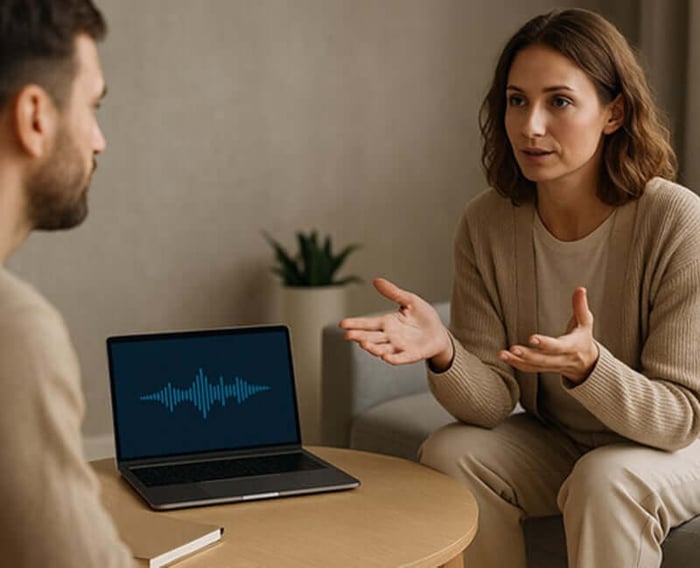
The best voice can vary based on the particular course type for mental health or coaching.
For Therapeutic and Mindfulness Courses
For stress-reduction, meditation, or emotional-regulation courses, a soothing, gentle voice is needed. The voice should be smooth, with a slow, even rate and soft tone. The objective is to induce a sense of calm and safety, leading the listener into a peaceful state.
For Life and Career Coaching
Conversely, a coaching course in motivation, goal setting, or career growth may be most receptive to an even more vibrant, but still peaceful, voice. It needs to be clear, assertive, and encouraging, with a feeling of possibility and empowerment. It is a voice more of a partner than a guide.
For Specialized Courses
Take, for instance, a course on trauma-informed care. Here, the tone has to be especially gentle. It needs to be non-judgmental and reassuring. It has to express deep empathy and respect for the listener's experiences, which would make them feel safe and cared for.
Voice is the essence of the delivery of your course. It's how you communicate with your audience on a personal level and what turns the content into a really powerful one. Align the voice with the mission of your course to create an experience that is not just informative, but transformational.
Conclusion
Selecting the optimal voice for a coaching or mental health course is an art and a science. It takes a profound knowledge of your audience, the psychological effect of vocal delivery, and sticking to honesty. The voice serves as the emotional anchor, leading learners through delicate issues and enabling them to make positive transformations. By taking the time and effort in making this most important decision, you make your course heard but also felt, making a deep and lasting impression on the lives of your students.